
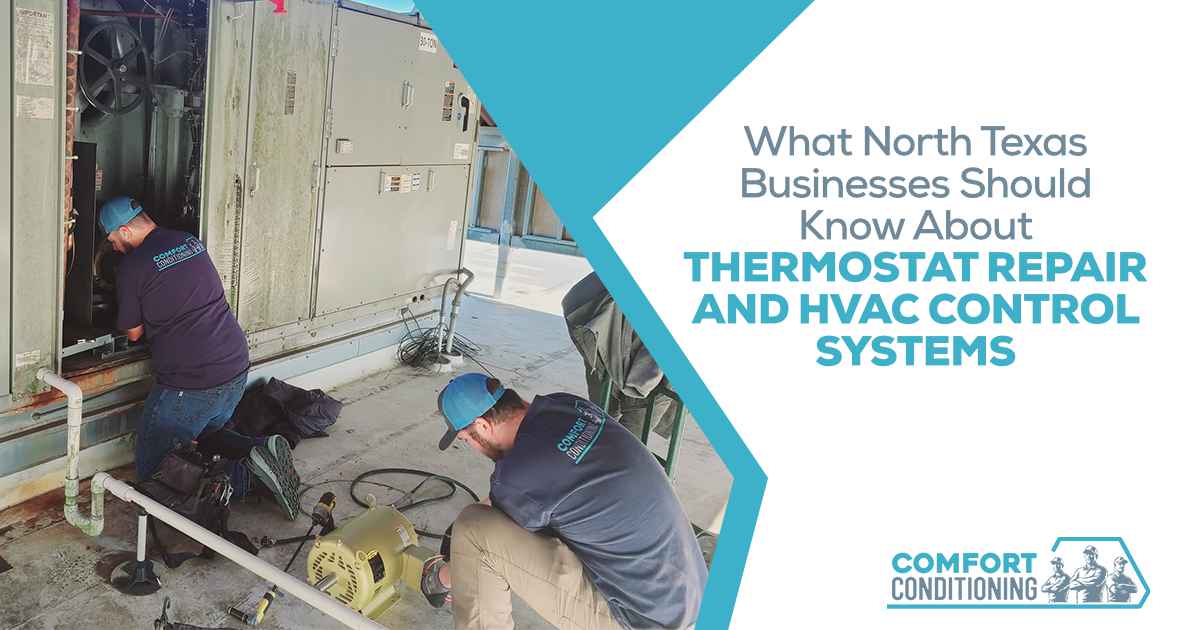
Commercial buildings depend on reliable temperature control to maintain comfortable and functional occupied spaces throughout the day. Unlike many residential systems, commercial HVAC systems may serve multiple areas with different temperature requirements, schedules, occupancy levels, and equipment configurations. When a commercial thermostat or HVAC control malfunctions, the problem can extend beyond comfort and affect normal business operations.
Commercial HVAC Thermostats: Why Business Controls Are Different
Commercial HVAC thermostat systems can have more complex control requirements because they often manage larger spaces and multiple conditioned areas. An office building, retail property, production facility, or other commercial environment may have different occupancy patterns and temperature needs throughout the day. These factors make dependable communication between thermostats, sensors, HVAC equipment, and other controls important for consistent system operation.
Commercial thermostat controls can also be tied to scheduling and occupancy requirements that determine when heating or cooling should operate. A control problem can therefore affect more than the temperature displayed on a thermostat because an incorrect command may cause equipment to operate at the wrong time or fail to respond when heating or cooling is needed. A control problem in one part of a commercial HVAC system can therefore affect comfort, scheduling, and normal operations across multiple occupied areas.
Commercial Thermostat Controls and Building Comfort
Reliable thermostat controls help maintain more consistent temperatures across areas used by employees, customers, tenants, or other occupants. When a thermostat provides inaccurate readings or sends inconsistent commands, one portion of a building may become too warm while another area remains too cool. These temperature differences can make the indoor environment less comfortable and may interfere with normal activities.
Commercial temperature control also plays a role in predictable HVAC operation throughout the workday. Thermostats and related controls help communicate when heating or cooling is needed based on the conditions detected within the building. If those readings or commands are unreliable, the HVAC system may not respond in the way building occupants expect.
Signs a Commercial Thermostat May Need Repair
Businesses may notice several warning signs when a commercial thermostat or related HVAC control begins malfunctioning. These symptoms can vary depending on the type of control system and the underlying problem, so they should not automatically be treated as proof that the thermostat itself has failed. Persistent or recurring control problems can indicate that professional evaluation is appropriate.
Inaccurate Commercial Thermostat Temperature Readings
One common sign of a commercial thermostat problem is a displayed temperature that does not appear to match actual conditions in the building. For example, occupants may report that an area feels significantly warmer or cooler than the temperature shown on the thermostat. An inaccurate reading can cause the HVAC system to respond based on incorrect information.
When the thermostat does not accurately reflect conditions in the occupied space, normal temperature adjustments may not resolve the problem. Repeated changes to the thermostat settings may temporarily alter conditions without addressing the reason the system is responding incorrectly. Businesses experiencing persistent discrepancies between displayed and actual temperatures may benefit from having the controls and related HVAC components evaluated.
Commercial Thermostat Fails to Control HVAC Operation
A thermostat may also appear to malfunction when commercial HVAC equipment does not respond as expected to temperature settings. Heating or cooling may continue longer than necessary, equipment may fail to start when conditions require it, or the controls may appear unresponsive. These symptoms can affect comfort and make it difficult for building occupants to maintain consistent indoor conditions.
Such symptoms do not necessarily mean that the thermostat is defective. Problems involving HVAC equipment, system controls, sensors, or communication between components can sometimes produce similar behavior. A proper diagnosis can help determine whether the thermostat is the source of the issue or whether another component is affecting HVAC operation.
Frequent Temperature Swings in Commercial Spaces
Frequent temperature changes throughout a commercial space can be another indication that the temperature control system is not operating consistently. Occupants may notice that an area becomes unusually warm or cool even though the thermostat settings have not changed. Repeated temperature swings can make a workspace or customer-facing environment uncomfortable and difficult to manage.
Inconsistent temperature control may have several possible causes, including inaccurate readings or unreliable control signals. The thermostat should therefore be considered as part of the broader HVAC control system rather than automatically identified as the sole source of the problem. Persistent fluctuations warrant closer evaluation when normal thermostat adjustments do not correct the issue.
Commercial Thermostat Display or Control Problems
Visible problems with a commercial thermostat can also provide an early indication that a control requires attention. A blank display, unresponsive controls, unexpected settings, or scheduling behavior that does not match the building’s normal operation can interfere with temperature management. Communication problems between the thermostat and HVAC equipment may create additional symptoms that are not immediately obvious from the control itself.
Businesses should pay attention when these issues occur repeatedly rather than assuming that a temporary adjustment has resolved the problem. A control that repeatedly loses settings or behaves unpredictably may continue affecting HVAC operation even when the building temporarily returns to a comfortable temperature. Recurring control problems may warrant evaluation of the thermostat and related HVAC components.
How Thermostat Problems Can Mask Larger HVAC Issues
A thermostat problem does not always originate with the thermostat itself. Commercial HVAC systems contain interconnected components, meaning a problem elsewhere in the system can sometimes produce symptoms that appear to be related to the thermostat or its controls. Conversely, a malfunctioning control can affect how other HVAC equipment operates and make a larger system problem more difficult to identify.
Thermostat Problems Versus HVAC System Problems
A business may notice that a thermostat is not maintaining the expected temperature and assume that replacing the control will solve the problem. However, the underlying issue could involve HVAC equipment or another component that influences how the system receives, interprets, or responds to temperature commands. Replacing a thermostat without evaluating the surrounding system may therefore fail to address the actual cause of the problem.
The relationship between the thermostat and HVAC equipment makes diagnosis especially important in commercial environments. Controls, sensors, equipment, and other connected components can influence overall system behavior. Looking at the complete control and HVAC system can provide a clearer understanding of why a particular symptom is occurring.
Why Commercial HVAC Diagnosis Matters
Professional diagnosis can help determine whether a persistent thermostat problem originates with the control itself or with another part of the HVAC system. The appropriate response depends on the actual source of the malfunction rather than simply the most visible symptom. A thorough evaluation can help businesses avoid relying on repeated thermostat adjustments when a deeper issue may be present.
Commercial properties can have more complicated operating requirements than a single residential space. Multiple conditioned areas, different schedules, and interconnected controls can make isolated troubleshooting less reliable. Identifying the underlying issue can help businesses make informed decisions about addressing the HVAC control problem.
Commercial HVAC Control Systems and Operational Reliability
Reliable commercial HVAC controls support more predictable temperature management throughout occupied areas. When thermostats and related controls function properly, businesses can maintain more consistent indoor conditions and reduce the likelihood of unexpected temperature-related disruptions. Dependable controls are therefore part of maintaining a stable commercial environment.
Reliable Thermostat Controls for Business Operations
Consistent thermostat operation can help businesses maintain predictable heating and cooling across occupied spaces. Reliable controls can also make it easier for HVAC equipment to respond appropriately to changing temperature conditions and scheduled operating requirements. This can contribute to a more stable indoor environment for employees, customers, tenants, and other occupants.
Energy efficiency can also be influenced by how effectively an HVAC system responds to temperature requirements, but it should not be viewed as the only reason to address thermostat problems. The more immediate concern for many businesses is maintaining dependable temperature control and avoiding unnecessary disruption. Addressing persistent control problems can help keep the HVAC system operating in a manner consistent with the building’s needs.
HVAC Control Problems Can Affect More Than Comfort
Commercial thermostat issues can affect daily operations when temperatures become inconsistent or HVAC equipment behaves unpredictably. Employees may find certain work areas uncomfortable, customers may notice temperature problems in public spaces, and businesses may have difficulty maintaining appropriate conditions throughout an occupied building. These effects can make a relatively small control problem more noticeable as it continues.
The impact can be particularly apparent when a thermostat repeatedly loses settings or fails to communicate properly with HVAC equipment. Temporary adjustments may provide short-term changes without resolving the underlying problem. Persistent control issues should therefore be considered in the context of overall HVAC operation rather than comfort alone.
When North Texas Businesses Should Address Thermostat Problems
Businesses should consider having a commercial thermostat or HVAC control issue evaluated when the same problem continues despite normal adjustments. Recurring temperature problems, inconsistent responses from HVAC equipment, and controls that repeatedly lose settings can indicate that additional diagnosis is needed. Persistent symptoms may involve the thermostat, the control system, or another HVAC component.
Certain recurring issues deserve particular attention:
- A thermostat repeatedly loses programmed settings or schedules.
- HVAC equipment responds inconsistently to thermostat commands.
- Temperature problems continue after normal thermostat adjustments.
- A control becomes repeatedly unresponsive or displays unexpected behavior.
- Temporary adjustments resolve the problem only for the issue to return.
These signs do not establish a specific diagnosis on their own. Instead, they indicate that continued adjustments may not address the underlying cause. Professional evaluation can help determine what is affecting the system’s operation.
When Professional Commercial Thermostat Evaluation Is Appropriate
Professional evaluation can help businesses determine whether a thermostat, its controls, or another HVAC component is responsible for persistent temperature and system-operation problems. Examining the relationship between the thermostat and surrounding HVAC equipment can provide a clearer understanding of why the system is behaving unexpectedly. This approach is particularly useful when symptoms continue despite normal adjustments.
Businesses experiencing persistent commercial thermostat problems can learn more about thermostat repair as part of addressing control-related HVAC concerns. The goal of an evaluation is to identify the source of the problem rather than assume that every thermostat symptom requires the same solution.
Schedule Commercial HVAC Service
North Texas businesses experiencing recurring thermostat problems, inconsistent temperature control, or unexpected HVAC responses can contact Comfort Conditioning for professional commercial HVAC service. Professional evaluation can help identify the source of persistent control problems and support more reliable operation of the building’s heating and cooling system.