
Commercial HVAC
Professional Heating, Cooling, and Ventilation Solutions for Business Properties
Contact Us
Commercial HVAC systems serve business facilities requiring specialized heating, cooling, and ventilation solutions that differ significantly from residential applications. These systems handle larger spaces, operate continuously during business hours, and must maintain consistent temperatures for employee comfort and productivity. Commercial HVAC encompasses rooftop units, split systems, variable refrigerant flow systems, and centralized building automation controls designed for office buildings, retail stores, restaurants, warehouses, and manufacturing facilities. Comfort Conditioning LLC provides licensed commercial HVAC technicians who understand the unique demands of business operations, including off hours service scheduling, energy efficiency requirements, and compliance with commercial building codes. Our technicians work with property managers, facility directors, and business owners to maintain optimal indoor air quality and temperature control throughout commercial spaces.
When to Consider Commercial HVAC
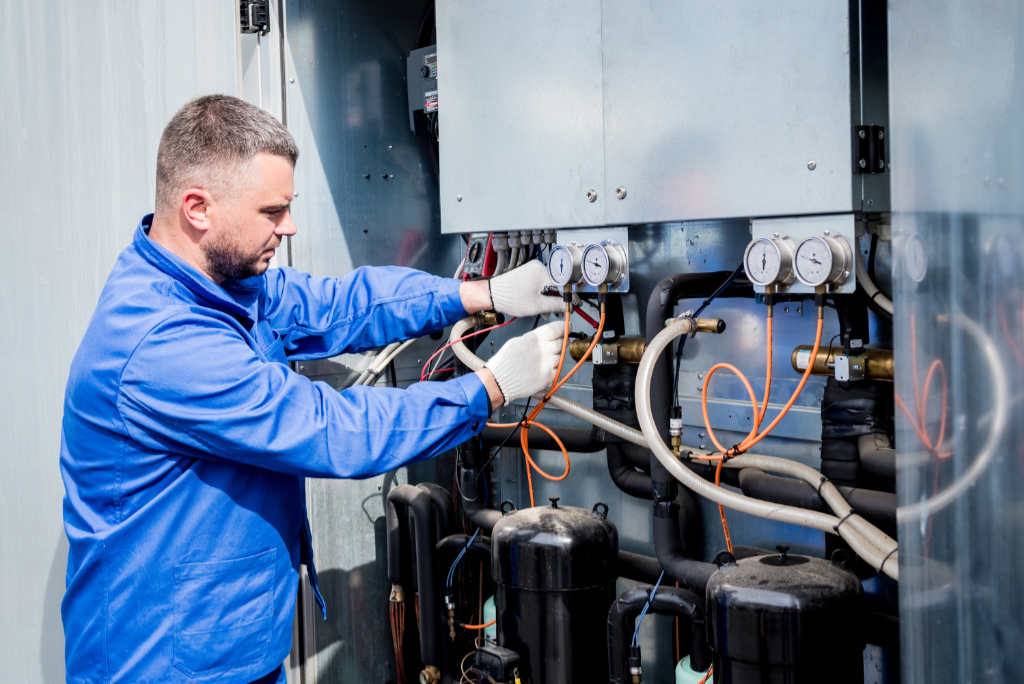
Commercial HVAC becomes necessary when businesses require climate control systems capable of handling large square footage, multiple zones, and continuous operation demands that exceed residential capacity. Office buildings need commercial HVAC when standard residential units cannot maintain consistent temperatures across conference rooms, cubicle areas, and private offices while accommodating varying occupancy levels throughout the day.Retail establishments require commercial HVAC systems to create comfortable shopping environments that encourage customer dwell time while managing heat loads from lighting, electronics, and varying foot traffic patterns. Restaurants and food service facilities need specialized commercial HVAC solutions that handle kitchen exhaust requirements, dining area comfort, and health department ventilation standards simultaneously.
Manufacturing and warehouse facilities require commercial HVAC systems designed for high-ceiling spaces, equipment heat loads, and air quality standards that protect both workers and inventory. Medical offices, dental practices, and healthcare facilities need commercial HVAC systems meeting strict air filtration requirements and maintaining precise temperature and humidity control for patient comfort and equipment protection. These commercial applications differ from residential needs because they involve building automation systems, variable air volume controls, economizer functions, and integration with fire safety systems that require specialized knowledge and certification to service properly. Educational institutions trigger commercial HVAC requirements when serving more than 50 students or operating in buildings exceeding 10,000 square feet, necessitating compliance with ASHRAE Standard 62.1 for ventilation and International Mechanical Code provisions for educational occupancies. Data centers and server facilities require commercial HVAC systems with redundant cooling capacity, precise humidity control between 40-60% relative humidity, and 24/7 operation capabilities to prevent equipment failure that could result in thousands of dollars per minute in downtime costs. Hotels and hospitality venues need commercial HVAC systems when guest room counts exceed 20 units or total building area surpasses 15,000 square feet, requiring individual room climate control, corridor pressurization, and compliance with OSHA indoor air quality standards. Industrial facilities manufacturing pharmaceuticals, electronics, or precision components must install commercial HVAC systems meeting FDA, ISO 14644, or other industry-specific cleanroom standards that mandate HEPA filtration, laminar airflow patterns, and contamination control protocols. The transition from residential to commercial HVAC typically occurs when cooling loads exceed 5 tons (60,000 BTU/hr), requiring three-phase electrical service, rooftop or ground-mounted equipment installations, and compliance with local building codes that mandate professional design and installation by licensed contractors. Timing considerations become critical during building construction phases, as commercial HVAC rough-in must coordinate with structural, electrical, and plumbing trades to avoid costly conflicts and schedule delays that can extend project completion by 4-8 weeks. Emergency replacement scenarios demand immediate commercial HVAC intervention when existing systems fail in critical environments like hospitals, where patient safety requires backup systems and redundant capacity to maintain life-supporting environmental conditions. Seasonal installation windows present cost implications, with peak summer and winter periods increasing equipment and labor costs by 15-30% compared to shoulder seasons when contractor availability improves and manufacturer incentives reduce material expenses. Improper system sizing represents the most common commercial HVAC mistake, with undersized systems causing continuous operation, excessive wear, and inability to maintain design conditions, while oversized systems create short-cycling, humidity problems, and energy waste that increases operating costs by 20-40% annually. Quality execution standards require certified technicians holding EPA Section 608 universal certification for refrigerant handling, NATE certification for installation competency, and state-specific mechanical contractor licenses that ensure compliance with local codes and safety regulations. Equipment selection must consider specialized components like variable frequency drives for fan motors, economizer controls for free cooling, demand-controlled ventilation sensors, and building automation system integration that enables remote monitoring and predictive maintenance protocols. Process details involve load calculations using ACCA Manual J commercial methods, ductwork design following ACCA Manual D commercial standards, and commissioning procedures per ASHRAE Guideline 0 to verify system performance meets design specifications before occupancy. Risk factors from improper handling include refrigerant leaks causing EPA violations with fines up to $37,500 per day, inadequate ventilation creating indoor air quality problems leading to sick building syndrome lawsuits, and fire safety system integration failures that compromise building evacuation procedures and insurance coverage requirements.
Services Available
Commercial HVAC Repair
Commercial HVAC repair addresses equipment failures in business settings where downtime directly impacts operations and revenue. These repairs often involve rooftop units, large capacity air handlers, and building automation system troubleshooting that requires after-hours scheduling to minimize business disruption. Commercial repair work typically involves more complex diagnostic procedures and specialized replacement parts with longer lead times than residential applications.
Commercial HVAC Installation
Commercial HVAC installation involves designing and implementing climate control systems for new construction or major renovations in business facilities. These installations require coordination with general contractors, adherence to commercial building codes, and integration with existing electrical and plumbing infrastructure. Commercial installations typically involve crane work for rooftop units, extensive ductwork modifications, and building automation system programming that extends project timelines beyond residential work.
Duct Repair
Commercial duct repair addresses air distribution problems in large building systems where damaged or disconnected ductwork can waste significant energy and create uncomfortable working conditions. Commercial ductwork often runs through drop ceilings, mechanical rooms, and rooftop installations that require specialized access equipment and coordination with building management. These repairs frequently involve larger diameter ducts and commercial-grade insulation materials that differ from residential applications.
Thermostat Installation
Commercial thermostat installation involves programmable and smart building control systems that manage multiple zones and integrate with energy management systems. These installations require understanding of commercial building automation protocols, occupancy scheduling, and integration with existing building management systems. Commercial thermostats often control larger systems and require specialized programming for optimal energy efficiency during business hours versus unoccupied periods.
Why This Matters
Commercial HVAC matters because business operations depend on maintaining comfortable working environments that support employee productivity and customer satisfaction while managing significant energy costs that directly impact profitability. Commercial buildings typically consume 40-60% more energy per square foot than residential properties, making efficient HVAC operation critical for controlling operating expenses and meeting corporate sustainability goals. Improperly maintained commercial HVAC systems can lead to indoor air quality problems that affect employee health, increase sick days, and potentially expose businesses to liability issues with workers compensation claims and OSHA violations.
Commercial HVAC systems operate under more demanding conditions than residential units, running continuously during business hours and handling greater temperature differentials, which accelerates wear and requires proactive maintenance to prevent costly emergency repairs during critical business periods. Building codes for commercial properties mandate specific ventilation rates, emergency shutoff procedures, and integration with fire safety systems that require specialized knowledge to maintain compliance and avoid code violations that can result in fines or forced closure. Energy efficiency in commercial HVAC directly correlates with utility costs that can represent 20-30% of a building's total operating expenses, making proper system sizing, regular maintenance, and strategic upgrades essential for long-term financial performance. Commercial tenants and property values depend on reliable climate control systems, as HVAC problems can lead to lease disputes, tenant turnover, and decreased property marketability that affects long-term investment returns.
Commercial HVAC systems must comply with ASHRAE Standard 62.1, which dictates minimum ventilation rates of 15-20 cubic feet per minute per person in office spaces, with higher requirements for restaurants and manufacturing facilities reaching 75 CFM per person. OSHA regulations under Section 5(a)(1) require employers to maintain safe working conditions, including proper ventilation to prevent heat-related illnesses and exposure to airborne contaminants. The International Mechanical Code mandates emergency shutoff switches within 50 feet of equipment access points and requires integration with fire alarm systems for automatic shutdown during emergencies. Non-compliance with these codes can result in fines ranging from $5,000 to $70,000 per violation, plus mandatory system shutdowns that halt business operations until corrections are completed.
Delayed maintenance creates cascading financial impacts that extend far beyond repair costs. A chiller failure in a 50,000 square foot office building during peak summer conditions can cost $15,000-25,000 per day in lost productivity, emergency rental equipment, and expedited repair services. Restaurants face immediate food spoilage risks worth thousands of dollars, while retail establishments lose customer traffic when indoor temperatures exceed 78°F. Manufacturing facilities with temperature-sensitive processes may lose entire production runs worth hundreds of thousands of dollars. Preventive maintenance contracts typically cost $2,000-5,000 annually for medium-sized commercial systems but prevent emergency repairs that average $8,000-15,000 per incident.
Improper handling of commercial HVAC systems creates significant safety risks and equipment damage. Refrigerant leaks from systems containing R-410A or R-134A require EPA-certified technicians for recovery and disposal, with improper handling resulting in fines up to $37,500 per day. Electrical components in commercial systems operate at 208V, 240V, or 480V, requiring lockout/tagout procedures and qualified electricians to prevent electrocution injuries that result in average workers compensation claims of $85,000. Gas-fired equipment requires annual combustion analysis and carbon monoxide testing to prevent dangerous gas leaks that can evacuate buildings and trigger emergency response costs exceeding $50,000.
Quality execution standards for commercial HVAC involve specific equipment specifications and installation protocols that directly affect system longevity and efficiency. Variable frequency drives must be programmed for proper motor acceleration curves to prevent premature bearing failure in large fans and pumps. Ductwork installation requires sealed joints tested to 1.5 times operating pressure with leakage rates below 3% to maintain energy efficiency ratings. Refrigerant line sets need proper insulation with vapor barriers to prevent condensation damage in ceiling spaces, while control systems require calibration within 2°F accuracy to maintain comfort standards and energy efficiency.
Common mistakes in commercial HVAC management include oversizing equipment by 20-30% to account for extreme conditions, which reduces efficiency and increases operating costs by $2,000-5,000 annually. Neglecting filter changes every 30-90 days increases energy consumption by 15% and reduces equipment life by 2-3 years. Improper economizer operation wastes 10-15% of cooling energy when outdoor air dampers fail to modulate correctly. Inadequate water treatment in cooling towers leads to scale buildup, biological growth, and corrosion that reduces heat transfer efficiency by 25% and requires expensive tube cleaning or replacement costing $10,000-20,000. Regular commissioning and retro-commissioning services identify these issues before they compound into major system failures that disrupt business operations and require emergency interventions during critical periods.